
Solar Microgrid System with Grid-Forming Storage in Practice
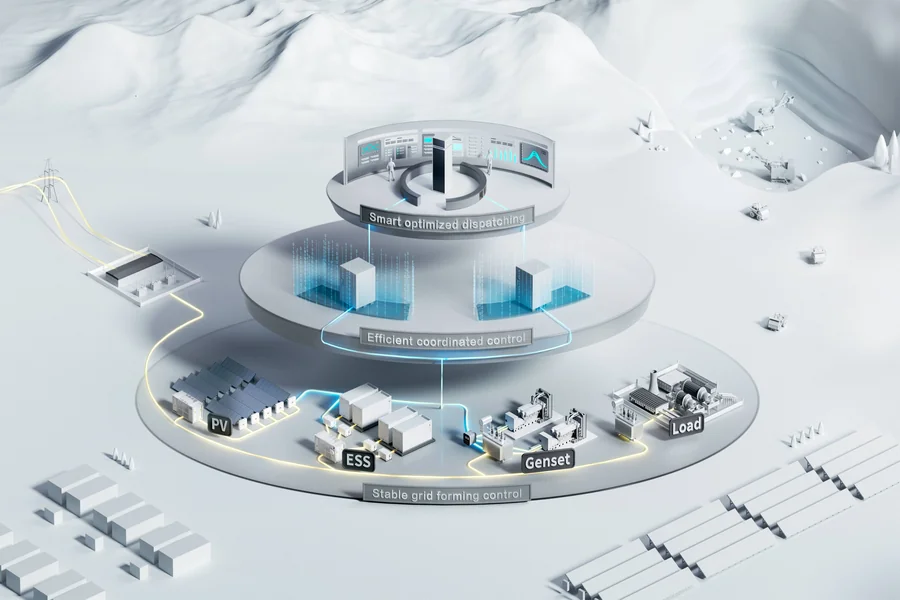
For an island system with substantial solar generation, equipment decisions must follow the required service and the conditions of the actual site. A solar microgrid system combines photovoltaic generation with local distribution, energy storage and coordinated controls so selected loads can operate under defined grid-connected or islanded conditions. The Huawei FusionSolar Smart Microgrid portfolio lists grid-forming storage, PV equipment, SPMS2000 and the SPPC2000-MGCC controller. In this context, solar microgrid system brings together specific components and controls rather than a single isolated device.
High renewable shares create a need for controls that manage storage reserves and rapid fluctuations in solar generation. Equipment ratings, control policies and the responsibilities of the operating team should therefore be aligned before commissioning. A design assumption should be documented when it cannot yet be confirmed by measurements.
The major equipment layers
PV controllers convert solar DC output into usable electrical power, while battery energy storage provides controllable energy and, in a grid-forming configuration, a reference for voltage and frequency. Distribution equipment connects these resources to critical and flexible loads.
Huawei’s published microgrid architecture includes smart string grid-forming ESS, a dedicated microgrid controller and a plant management system. Each contributes a different layer of fast electrical response, supervisory coordination or operational visibility.
Grid-forming and switching
During islanded operation, grid-forming equipment establishes local electrical conditions rather than relying on the utility reference. Protection and control settings must allow stable operation through the range of expected load steps.
The microgrid controller coordinates connected and islanded operating modes. Planned disconnection, unplanned grid loss and restoration each require a defined sequence that is verified against the capabilities of the installed devices.
Dispatch and visibility
Meters at the point of connection and across major assets help the controller understand import, export and islanded power balance. Incorrect polarity, inconsistent timestamps or communication loss can distort dispatch calculations.
Operators should be able to see PV production, battery state of charge, generator status, major loads and protection events in a coherent view. Alarm priority helps distinguish an urgent instability event from routine maintenance.
Design verification and expansion
Microgrid studies need load profiles, motor starts, fault levels, solar variability and generator dynamics. The vendor describes digital and hardware-in-the-loop simulation for testing control stability before equipment is commissioned.
Site testing should cover black start where supported, islanded load steps, planned grid return and failure of a major resource. The accepted operating envelope should be documented rather than assumed from a generic architecture image.
These considerations show why solar microgrid system should be specified by its architecture, operating limits and interfaces. A solar microgrid is not simply PV connected to a battery. Its capability depends on grid-forming behavior, coordinated source dispatch, appropriate protection and validated control transitions between operating modes. The final selection still depends on applicable standards, actual site conditions and model-specific documentation.


