Resin Injection Gains Ground as a Low-disruption Solution for Shopping Centre Floors
Shopping centres and retail parks are increasingly looking for repair methods that allow them to remain open while structural work is carried out. In this context, resin injection is becoming a practical option for stabilising floor slabs affected by settlement, voids or weakened support beneath the surface. Unlike traditional repairs, which may require demolition, excavation and the reconstruction of support layers, resin injection can often be completed through small access holes drilled directly into the slab. The process introduces an expanding material beneath the floor, where it fills voids and improves the behaviour of loose or poorly compacted ground.
A method designed for live commercial environments
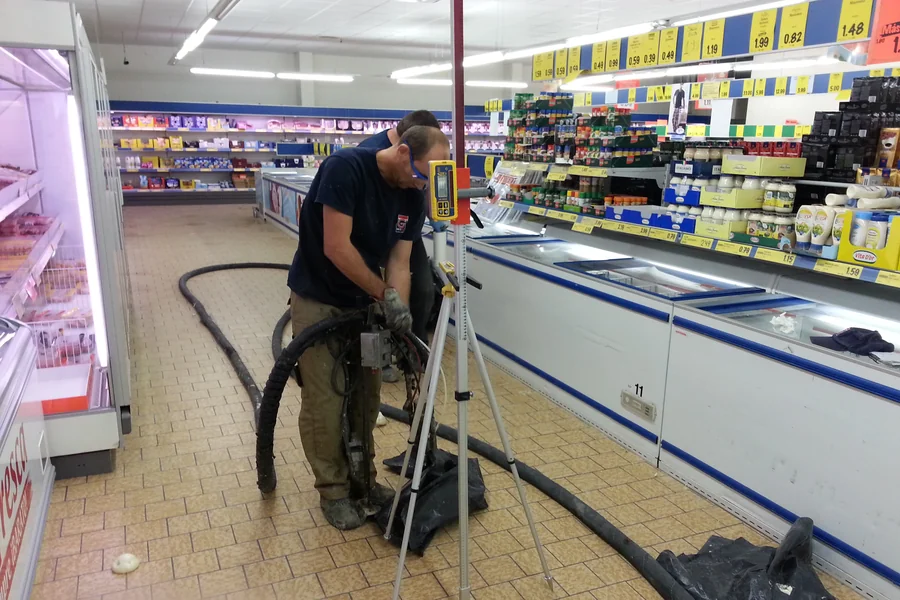
Retail buildings present specific operational challenges. Pedestrian routes, deliveries, tenant activity, noise restrictions and safety controls must all be considered before work begins. Resin injection can reduce the size of the working area and limit the need for heavy machinery, helping facilities teams organise repairs around trading hours.
The method is particularly relevant when the slab remains structurally recoverable but has lost continuous support. Resin injection is used to improve contact between the slab and the underlying ground, reducing movement without removing large sections of flooring.
GEOSEC Ground Engineering applies this approach in commercial assets where maintaining access and limiting disruption are central project requirements. Resin injection does not eliminate the need for careful planning, but it can shorten occupation times and reduce dust, spoil and noise compared with more invasive alternatives.
Diagnosis remains essential before intervention
Floor instability in shopping centres can result from poor compaction, moisture-related deterioration, loss of fines, repetitive loading or local void formation. These problems may lead to rocking slabs, cracking, uneven joints and local changes in floor level.
Before resin injection is selected, engineers must identify the cause and depth of the problem. They must also assess whether water leaks, drainage defects or deeper ground movement are contributing to the damage. Resin injection is most effective when the defect is linked to a support condition that can realistically be improved from above.
During the work, the material is introduced in controlled stages. Resin injection must be monitored carefully to avoid excessive movement and to ensure that the objective remains consolidation rather than uncontrolled lifting. The intervention pattern can be adjusted according to the condition of each area.
Operational continuity becomes part of the repair strategy
For owners and asset managers, the value of resin injection extends beyond the engineering result. Reduced closures can limit lost trading time, avoid unnecessary removal of finishes and simplify coordination with tenants and maintenance teams.
Resin injection can also be phased across corridors, service zones, loading areas or individual retail units. This flexibility allows work to progress while unaffected parts of the building remain in use.
As commercial properties place greater emphasis on continuity, cost control and efficient maintenance, Resin injection is gaining relevance as a targeted response to slab instability. Its main advantage lies in combining ground improvement with a limited operational footprint, making it suitable for live retail environments where disruption carries a direct commercial cost.